A review and highlight reel of table top board games and whatever other nerdery I participate in.
what the hell is this blog anyways?
To the 3 people that will read this...
Expect game reviews and replays from our weekly game. I may also talk City of Heroes, movies, books and whatever else catches my fancy.
Saturday, January 28, 2012
Nerdy Friday recap - that's no moon
games played: Space Alert, 7 Wonders and Lost Cities the board game.
Space Alert : Fun co-op game. there are no winners are losers, unless Captain Juan is running the ship, then d00m. Three cheers for Captain David, who led the crew to an amazing comeback.
7 Wonders: way to go Juan winning with the cheap military.
Lost Cities: Juan and Mike won single rounders, hooray for them!
Friday, January 27, 2012
F$@& Spin offs and Expansions
Spin offs and Expansions
Mike (and RxDocSF a bit later) touched on something in the Catan topic that I thought would make a good article, thanks Mike (and doc).
“My main problem with Settlers of the Catan (sic) has less to do with the game and more to do with the marketing. It has like eight? expansions now.”
Yeah good point. I honestly haven’t played any of the expansions, but I have played some of the spin offs/sequels. When your board game needs a wiki for its product line you have gone way too far.
Mayfair is frankly awful about this. Their Crayon rails were even worse. Empire Builder/NorAm rails and EuroRails were solid games. I played or bought Nippon rails, British rails and Iron Dragon (fantasy world). All of those sucked. The map in a tube was F%$^ing awful. The cards were cheap uncoated card stock. All in all, the materials got in the way of the game. And the games weren’t that good in the first place, especially the British and Nippon versions. England is dominated by London, and Japan by Tokyo. Duh. So when ¾ of the loads involve London/Tokyo, you have a dumb game.
So a summary of the bad: A few of these expansions were ok, most were awful, or perhaps better stated, unnecessary. They added layers of complexity to otherwise elegant games, bogging them down. I actually have utter disdain for nearly every spinoff produced. I think the only true winner was EuroRails.
Seguing into good expansions. I feel in most of these cases, the games were designed with expansions in mind.
In an attempt to keep the snark up, good expansions for games I don’t like.
Ok Munchkin the core game sucks. It’s cooperative until someone is about to win, then the table unites to gang beat the leader back down. This pretty much describes every card game Steven Jackson Games has ever released. However, if this is your thing, the expansions are great. They add new ways to screw with players, amusing weapons and silly art.
#6298 on BGG, and I think that may be a little harsh, but whatever, it’s not as if they are slamming a game I really like. Not having played any of the expansions, I really can’t get too detailed. But the game is throwing down map tiles, getting weapons and loot, and killing zombies. New map tiles, new weapons, and new ways to kill or be killed by zombies? Again, if this is your thing, the more the better! (with the caveat that this game already takes too long for the thought/luck involved. Map size stays the same please.)
The first two expansions were really good. They added more cards, made a couple paths to victory more viable. They had some bumps (takeovers?) but they listed these as ‘optional’. Enter expansion 3 , The Brink of War, and the introduction of prestige. Prestige DRASTICALLY changed the game, to the point acquiring prestige tokens is the most important part of the game now. I rated this expansion as 7/10 much to the dismay of Mike. I think I rated it that high because you can choose to play with new cards and ignore prestige. This will require sorting…there are cards that have prestige related powers that are now useless. Anyways the point is that expansion worked for this game, but they went just a little too far.
I haven’t played too many of these expansion; Intrigue and Seaside a lot, and Alchemy a touch. Dominon has the same basic problem as RftG. A couple of expansions worked, but the more you tweak the worse it gets. I played Alchemy only a touch, because after a couple trials, I decided I was done with the game.
Anything else? I’m sure someone has some words on M:tG, Warhammer and a slew of others but this post is already twice as long as my average. Someone else talk for a change.
Thursday, January 26, 2012
High ranking games I know nothing about
Who has played Through the Ages? (Chvatil!) It passed Puerto Rico at some point and now sits at #3. Four hours is a little much for my group, and maybe for me. I don't mind a four hours game, but I'm going to want to play it again the next two weeks...I might even leave it set up. But after playing a game, I usually want to get right back into it and try it again. Sometimes I want to try it again when we're only 15 minutes in :) "OOOH, I get it now, start over, start over!"
And who has played Twilight Struggle? It's the number one board game, war game, and strategy game. I'm beginning to think it's a BBG inside joke :)
F#$* Going First
In many games, initial turn order has a non-negligable impact on the game. Typically first is best. Sometimes last is best. In Stone Age, second seems best. If you're new to the game, first is definitely not best :)
I believed for a long time that games with many turns or rounds mitigated the advantage gained by going first (or turn order in general). Now I'm not convinced of that at all. Even in long games of chess, white has an advantage of between 52-56%. In very long games that we play like Eurorails, other players are routinely one or two turn away from going out when someone finally does. And many longer games can end that way - i.e. after several hours of play, one player goes out and ends the game a turn before another player would have. Settlers can be that close, and Ticket to Ride as well. Furthermore, lots of turns of low impact incremental moves is a dramatic limitation for game designers.
Many games we play now have 10 or fewer (LONG) rounds. And some of these games allow a player multiple atomic actions in a row. A game like Steam for example does this which I'll probably review next week. Brass is like this, although it has two phases of between 8 and 10 turns.
Some games deal with the natural benefits of going first simply by penalizing that player in some other way. In Magic the Gathering the player who goes first skips their draw phase. In Through the Desert instead of placing two camels in the first round, the first and second player only place one. When Darren discussed "fixing games", one suggestion for Stone Age was to adjust the amount of food for the players in the weaker positions (order of those players beginning with the weakest - 4th, 3rd, and 1st). This seems like a reasonable way to attempt to resolve the problem, however finding the right balance is difficult. Magic could have adjusted the life of the second player up for example, but the impact of that could be far reaching. And there aren't always a lot of avenues available for tweaking, how would you modify chess for example? Move a piece into play? What about checkers? Wait checkers? Forget I said that.
Notre Dame uses another technique - there is little player interaction and all players get the same number of moves. I don't think this is unique, but I can't think of another games that handle the problem this way.
Maybe this is one reason I'm so enamored with Vlaada Chvatil at the moment...in Galaxy Trucker, NO ONE GOES FIRST! Same thing with 7 Wonders and Race for the Galaxy. It's all simultaneous. These games have the added advantage that you are rarely waiting for the action to pick up again. These games also tend to have little or no player interaction though, and whether you like that feature or not, it certainly limits a game designer in what they can do.
The lesson for me is that the trick to de-emphasizing turn order is to keep all players involved during all turns. Galaxy Trucker, 7 Wonders, and Race for the Galaxy obviously all do this well by avoiding individual turns entirely. But Bohnanza, Traders of Genoa, Settlers of Catan and Ra do this well too, in different ways though. Bohnanza and Settlers do it with trading. You can improve your position even when it's another players turn. Ra does it with very quick action and the threat of a new auction at any time. Genoa gives every player an action on each players turn, so you involved the entire way. For me, all these mechanics are successful. But results may vary - I like things to stay moving so I can be involved. I hate to wait, the airport is about my least favorite place in the world. Anyway, being involved also keeps the game balanced because I can improve myself even when it's not my turn. The main player has more actions and abilities, but I have some too, and sometimes a limited ability to impact what he can do.
One last comment. Carcassonne is a bit of a mystery to me. Did you know that there are 71 tiles in the basic game? (does not include the start tile). 71 is prime. This ensures that the last player will get fewer turns than the first player. Why is that? Why did the designer Klaus-Jürgen Wrede do that? Seems intentional, right? Were I designing it my first thought would be to remove some tiles (number depending on number of players) to ensure that each player gets the same number of turns. Perhaps Wrede began that way as well, but evolved his thinking to give the first player an extra turn. Hard to say. Thoughts?
I believed for a long time that games with many turns or rounds mitigated the advantage gained by going first (or turn order in general). Now I'm not convinced of that at all. Even in long games of chess, white has an advantage of between 52-56%. In very long games that we play like Eurorails, other players are routinely one or two turn away from going out when someone finally does. And many longer games can end that way - i.e. after several hours of play, one player goes out and ends the game a turn before another player would have. Settlers can be that close, and Ticket to Ride as well. Furthermore, lots of turns of low impact incremental moves is a dramatic limitation for game designers.Many games we play now have 10 or fewer (LONG) rounds. And some of these games allow a player multiple atomic actions in a row. A game like Steam for example does this which I'll probably review next week. Brass is like this, although it has two phases of between 8 and 10 turns.
Notre Dame uses another technique - there is little player interaction and all players get the same number of moves. I don't think this is unique, but I can't think of another games that handle the problem this way.
Maybe this is one reason I'm so enamored with Vlaada Chvatil at the moment...in Galaxy Trucker, NO ONE GOES FIRST! Same thing with 7 Wonders and Race for the Galaxy. It's all simultaneous. These games have the added advantage that you are rarely waiting for the action to pick up again. These games also tend to have little or no player interaction though, and whether you like that feature or not, it certainly limits a game designer in what they can do.
One last comment. Carcassonne is a bit of a mystery to me. Did you know that there are 71 tiles in the basic game? (does not include the start tile). 71 is prime. This ensures that the last player will get fewer turns than the first player. Why is that? Why did the designer Klaus-Jürgen Wrede do that? Seems intentional, right? Were I designing it my first thought would be to remove some tiles (number depending on number of players) to ensure that each player gets the same number of turns. Perhaps Wrede began that way as well, but evolved his thinking to give the first player an extra turn. Hard to say. Thoughts?
Wednesday, January 25, 2012
F@%& Settlers of Catan
Plot: Uh. Colonize an island or something.
Goal: It's a game about victory points, 1st player to 10 wins!
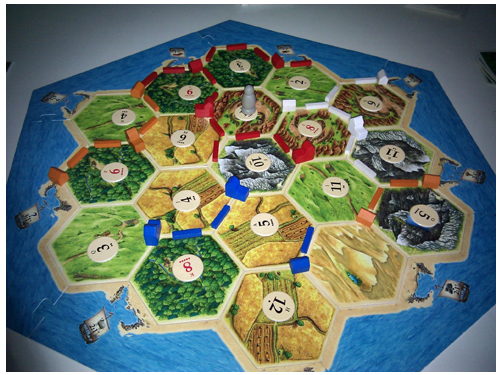
Set Up: The genius of this game is in the set up. There are 19 resource tiles: 4 sheep pastures, 4 wheat fields, 4 wood lots, 3 clay pits, 3 stone quarries and 1 desert. In addition there are 9 ports: 5 specific for a resource and 4 generic. Resource and port tiles are placed randomly in such a way to form an island, see below.
There's a lot of replay here, something along the order of 19! (that's 19 factorial) different possibilities for the map. Ok it's a lot less than that because of duplicate tiles, but let me assure you there are a lot of combinations. But WAIT there's more. Each resource tile gets a number from 2-12 assigned to it. Those numbers correspond to the results on 2D6, if that tile's number hits, a resource is potentially generated. There are specific rules for assigning these numbers, specifically to make sure that the higher probability results aren't right next to each other.
Gameplay: After set up, a snake draft occurs. Player 1 picks a spot on the map to place a settlement and a road, then onto player 2 then player 3, then player 4 twice then back down the line. So the player 1 theoretically gets best and 8th best spot. The 2nd spot picked gives you some starting resources.
So the twist. 7 is not applied to any resource. Instead a 7 activates the robber (robber starts in the desert.). The player who rolled the 7 moves the robber to a new tile, and can steal a resource from someone with a settlement on that tile. That tile is also now interdicted, if it's number comes up, no resources are generated. Also a 7 forces a discard check, anyone with over 7 resources must discard half.
Game ends when someone reaches 10 VP. Settlements are worth 1 VP each, but you only get 5 of them. Cities are worth 2 VP and recycle a settlement back into stock. Having the longest road gets 2 VP, the largest army gets 2 VP and some action cards give 1 VP.
Tactics: It is extremely hard to win this game without cities. To do that you would need to play all 5 settlements, have the longest road, the largest army AND draw a VP action card. So the resources for cities are really important; you need a lot of stone. How you get that stone varies, but you absolutely need a plan for getting some. Sheep are the least useful, the recipes never require multiple sheep and they are only used for settlements and action cards.
Other than that, tactics are often contradictory. Drafting spots with high resource yields (the 6's and 8's) is important. So is getting hits on a big range of die rolls. So is having access to every resource. So is having the ability to get favorable trade ratios via the ports, and on and on...
Review: I still really like this game. It's fast paced and has lots of good decisions. Unfortunately its about 15 years old, which means I have had the opportunity to play this lots. It's not something I want to play often, but a once a month or every two months this would be great fun. 7.5/10
Tuesday, January 24, 2012
F*#$ Games From My Childhood
What did you play as a kid? My dad is/was a war gamer, so I played some crazy stuff. But mostly I played with the kids down the street, not my dad. I would beg my dad to play chess with me, and occasionally he would reluctantly agree. Then he'd crush me in approximately 5 moves, give me a book on chess, and tell me to go read it. "Rematch?"
"No."
We played a couple games though that I have sort of fond memories of. One was called "Dungeon" and in retrospect, it was a horrible game. It enjoys a generous ranking of 2835, I suspect that's more because so many are familiar with it rather than it's actual quality. But that's what they had in 1975.
(we had this alternate cover)
Dungeon was by TSR, and involved wandering around the board, kicking down doors, killing monsters, and taking their stuff.
We also had a game called Sorcerer's Cave which was good from far, but far from good. The concept was great, explore the cave, flip new rooms from a random deck, spread it all around your living room (see picture). But really, it was just an evolution of Dungeon with a nifty random map element thrown in.
It was a little clunky because if you went north and found a dead end, turn over. Determining the temperament of an NPCs involved rolling a single six-sided die. Combat was the same. Luck is fun! Well, not for me.
Sorcerer's Cave ranks a well deserved 2310.
I have some vague recollection of a game called 221B Baker's Street, where you tried to solve mysteries al la Sherlock Holmes. I also remember a game called By Jove which we never played because it came with a booklet of Greek myths that you had to familiarize yourself with. So my dad gave me the book and said "read this." And I didn't :) By Jove seems like it was an educational game anyway, and a rank of 7115 is the new record for games I looked up on purpose.
Anyhow, my friends down the street actually had most of the games we played together, so we played at their house. We played plenty of Risk, a little Axis & Allies, and a little Fortess America. (That's the one where, well, here, let me just paste the description from BBG: "From the west arrives hordes of Asian foes; from the south arrives a union of South American countries through Mexico, and from the east lands come legions of Soviets who have taken over all of Europe. America besieged has to rely on the remaining ground and air forces left in the country along with partisan uprisings to defend mom's apple pie." Ahhh Milton Bradley, those were the days. Well wait! Fantasy Flight is actually re-releasing this game. Because something new is too hard?) We also played some Talisman, this is before I dubbed it "the argument starter". The number of contradictions in the rules of that game was miraculous. Note the playing time, four hours. (Fantasy Flight also re-released this game as a 4th edition).
We played Dark Tower occasionally. I would play that game right now and I don't even remember how it worked. I remember that great midi music though, and the sound of the door slowly opening, and your units fighting the brigands round after round. I also remember my friends' tower breaking and that being the end of that. (2 minutes of Tower ecstasy on youtube here)
Less than $300 on eBay if you act fast!
Oh man, I loved Stratego. I would see that on a shelf at a random friends house and beg to play it. The sad thing is, I probably only played and finished a game like twice. I asked for Stratego for Christmas a few years in a row, nothing. Santa let me down. My mom just dumped a pile of old childhood memories on me and I came across one of those very Christmas lists with Stratego NUMBER ONE, obvious evidence my parents did not love me (Dad, if you're reading this, I'm sorry...but the proof is right there). I got Darren to play me in Stratego last week while we waited for the others to arrive. But like just like in my youth, we never actually finished.
Stratego was awesome. What concept! It had bombs, it had spies, it had surprises, it had subterfuge, it had strategy, it had bombs, it had tactics, it had bombs. The new sets have changed the numbering but not the play, someone decided that the best unit should be the highest, so they flipped all the numbers around. 10 is the best, 2 is the "scout". Whatever, it's still fun!
My son wants to play Settlers of the Catan (sic), badly. So finally, FINALLY, I taught him the basic rules last night. But before we did that, we had to learn all about probability. (It's tough being my son, Paul. I apologize now and I promise, I PROMISE, I'll pay for your therapy later.) I also made him learn about binary before he could play Minecraft. He's 8. I have a problem. But I digress. We play games together semi-regularly, more so now that he's older. Guess what our favorite is? Stratego.
Monday, January 23, 2012
F$@& The Sharing Knife
I am not a fan of Lois McMaster Bujold.
The Chalion Saga was better. At least I finished the first one, and it had an intriguing main character which kept me hooked. The follow up stories didn’t have that good characterization and I put them down after 50-75 pages.
But I loved The Sharing Knife.
The characters are strong. The female lead, Fawn, initially plays the ‘fish out of water’ archetype, so Bujold can explain how this world works. She’s not a passenger however but a genuine protagonist, and her ignorance mirrors her peoples (referred to as Farmers) and educating folks turns into a central theme. The male lead, Dag, is initially Fawn’s guide to his peoples (Lakewalkers) secrets. As the story progresses and Dag grows as a character, Fawn turns into his guide.
The world utilizes magic, referred to as ‘ground’. Ground is more like the concept of ‘the Force’ then sorcery. Lakewalkers can use ground to sense things, to do minor manipulations, but there’s very little earth shattering sorcery. The antagonists, ‘Malices’, are a combination of locusts and the movie Highlander. They suck the life out of everything they come into contact with, and gain the knowledge and power of anything they kill. They have but one weakness, a Lakewalkers death can be stored in a bone knife, and a malice stabbed with a Sharing Knife is taught how to die.
The series explores a lot of neat themes too. Lakewalkers patrol and hunt for malices because they are the only ones who can kill them. But they are secretive, so become feared and unappreciated. It’s an interesting societal dynamic, they protect a people they despise (some exaggeration for effect…). Dag is a Lakewalker and Fawn is a Farmer, so when they marry, it’s kind of a deal. And the clash of these societies is also interesting and is explored throughout the series.
4 books in the series. I think the 3rd is the strongest, and the 2nd is the weakest. But very much worth my time and I enjoyed them very much.
Subscribe to:
Posts (Atom)